State of Confusion

I have waited my entire life for one thing. And last night it finally happened! Leading up to last evening, I knew that there would be ugly crying. I am beyond grateful that they were tears of joy. Now you might be asking yourself, what could possibly be so important that I would hope and pray for one thing for several decades, without it coming to fruition? What one goal could be so meaningful as to inspire me to continue to remain optimistic year after year after year?

The Super Bowl of course! And last night, after decades of waiting, the Kansas City Chiefs won the Super Bowl! Just typing those words nearly invokes more ugly crying, but I will keep it in check long enough to address a very important issue…the existence of the apparently little known state of Missouri. Thanks to a rather infamous tweet immediately following last night’s game, I feel compelled to share a little excerpt from my manuscript that highlights the geographical conundrum that haunts me even now, twenty years after my departure from Kansas City.

I was born in Kansas City, Missouri, in a year that I do not wish to disclose as it forces me to remember my current age and somewhat recent(ish) milestone birthday. Now let us quickly dispense with the important burning questions. It is pronounced Missouri (miz-ur-ee) with an emphasis on the “ur” and with an “i” (long e sound). It is not “miz-er-uh.” You will note the lack of an “a” in its spelling. It is also not “misery” as the tired joke would suggest. But most importantly, Missouri and Kansas are not the same state. Yes there is also a Kansas City, Kansas. In fact, it shares a border with Kansas City, Missouri. But Missouri is still a separate state.  Why, you ask, would I state something so seemingly obvious? Well that is because ninety-eight percent of the time, the immediate response to the sentence “I am originally from Kansas City, Missouri” is one of the following questions or declarative statements:

  1. “Oh…what is it like growing up in Kansas?” I wouldn’t know. I just said I am from Missouri.
  2. “Wow. Kansas. So it’s really flat there, right?” Yeah, I have also heard that little rumor about Kansas. But I cannot speak from experience, as I grew up in Missouri.
  3. “Kansas? Well, I guess you’re not in Kansas anymore!” That is right. Because I wasn’t there to begin with…hence why I said I am from Kansas City, Missouri.

Now I could see how people might make assumptions had I merely stated “I am originally from Kansas City.” That would have left things open to interpretation and might invite the aforementioned questioning/commentary. However, knowing this reflexive dismissal of an entire midwestern state is so pervasive, I am always careful to include the “Missouri” after “Kansas City.” Even then, the questions are surprisingly the same. The even more surprising part is the varying degrees of incredulousness when confronted with the fact that there exists a Kansas City, within the state of Missouri. Some people seem convinced that I have fabricated its existence. When you find yourself defending your city’s existence to a flat-earther/alien conspiracy-theorist, you know that your city has an image problem. Then there are those that think perhaps I am really just from St. Louis, MO. Nope… that is yet another city within the state of Missouri, and it is on the other side of the state, no less. 

Of course for people who grew up in either KCMO or KCK as the vernacular goes, there are stereotypes about people who live in each of those cities and a very subtle rivalry on behalf of a few. Though I suspect that any real rivalry is likely born from the frustration that comes with having to explain, ad nauseum, the difference between Missouri and Kansas. Alright, I suppose that should suffice for the geography portion of our discussion. However, geographical rivalries aside, it is important to point out that given the proximity of Kansas, and the fact that it does not have a separate NFL team, a great many people in Kansas are Chiefs fans.

And as long as we are challenging assumptions here, I should add that I did not grow up on a farm, nor did I have cows. We did have dogs…many dogs…including two white and black ones. But no cows. And no, I have never milked a cow or any other farm animal, despite what you might ascertain given my deep love of all things dairy. I have been to farms (mostly my grandfather’s chicken farm in Arkansas as a child), so maybe that gives me a tiny bit of street cred….or pasture cred, as it were. But I just needed to dispel the myth that all of us from the Midwest grew up on farms, know how to birth a calf, and/or actually know the difference between hay and straw. Yes, there is a difference. No, I do not know what it is.

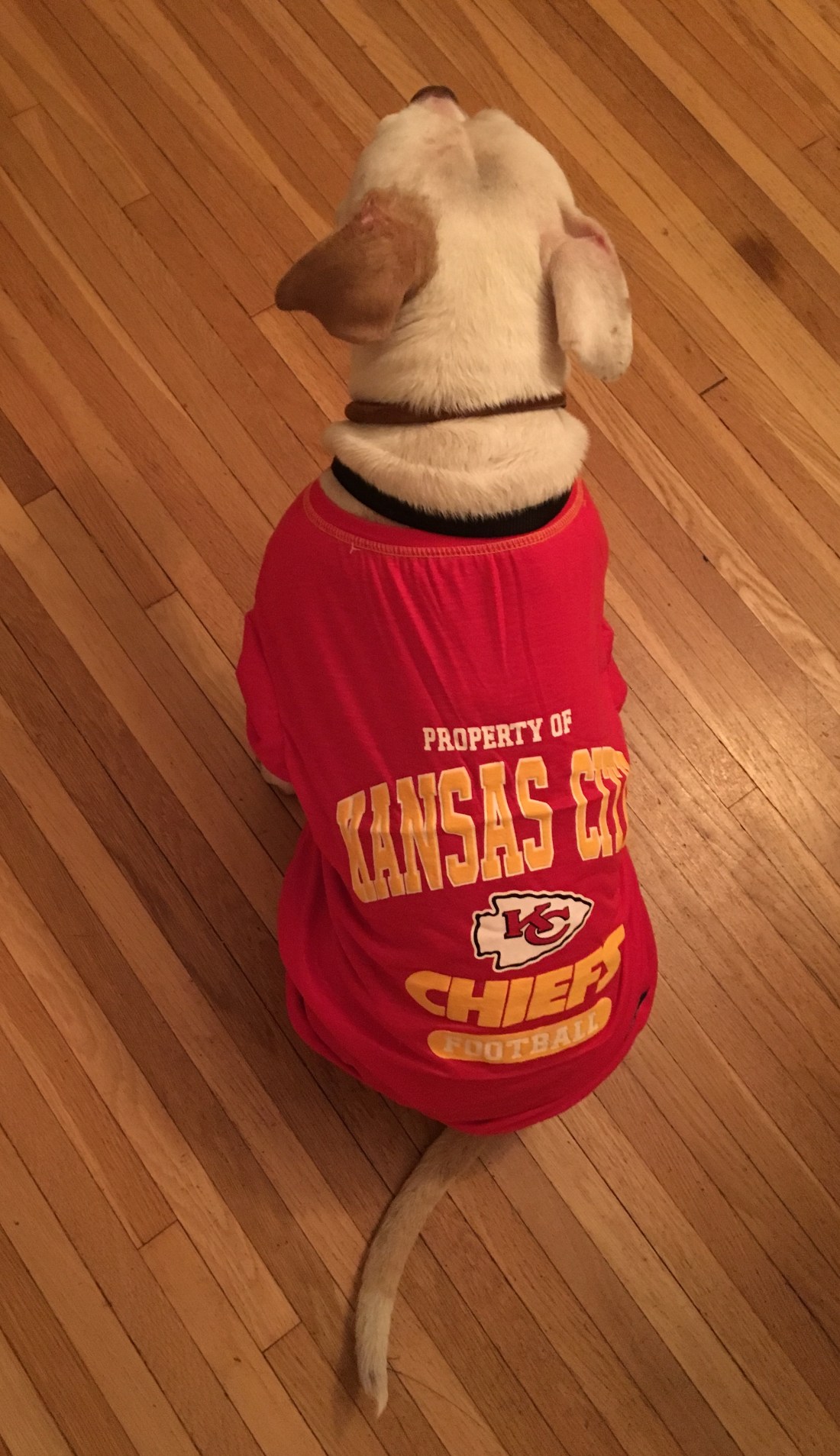
But what I do know is that Kansas City, is a city full of people so passionate about their Chiefs that even if they, say, move to California for many years, they still dress themselves, three kids, and one dog in Chiefs gear on Sundays…they still pace back and forth during important games, keeping hope alive year after year…and they still ugly cry when their beloved Chiefs win the Super Bowl! Congratulations to the Kansas City Chiefs, Super Bowl winners at long last!

The Double-Edged Scalpel

Eternally in a hurry, I uttered my standard-issue, “No, I’m sure it’s all fine. It’s just the typical surveillance testing,” excused myself from the call, and walked quickly toward the hospital.

Five hours of testing later, and I would find myself deflated and wondering if that statement had jinxed things, as I dressed and gathered the paperwork to schedule my next, unexpected biopsy.

Sometimes we become so very used to a particular behavior that it becomes second nature. This is true of a wide variety of both adaptive and maladaptive behaviors…eating healthy, working out, drinking enough water, smoking, working too much, gossiping, shutting people out, making excuses for other people. Actions are so powerful that, when repeated over time, they simply become part of who we are. And after 30 years of cancer survivorship, eleven surgeries, more than eleven procedures, sixteen different types of biopsies, and twenty-one MRIs, I am no different in that regard. Long ago I became so accustomed to reassuring other people that I would fine, that it is literally reflexive. My arguably canned response is always “I know it will be OK.”

However, this is a little more complex than merely trying to placate others with a submissive, disingenuous statement. Though I must admit I am more prone to doing so when really busy and lacking the bandwidth to really comfort other people. But there is something more than just mere habit and convenience at play. For starters, I really do believe that God and the universe (and perhaps a pinch of karma) will ensure that things will work out fine, one way or another. While faith, like anything, may wax and wane at times, it is always there anchoring the journey.

Furthermore, as I have written before, I really do believe survivorship is a “good problem to have.” I try to not lose sight of those who are no longer among us, but who would have given anything to have this type of “problem.” I have also had decades of hearing the phrase “it is probably nothing…but because of your history, we should biopsy… just to be sure.” In fact, during the otherwise seemingly endless days awaiting pathology results, it is not unheard of for me to temporarily forget that I am waiting for that call. Additionally, I recognize how fortunate I am to have insurance and access to great care, and appreciate that I have been blessed with doctors who do their due diligence to ensure that I remain cancer-free. Thus while it may not be ideal to have yet another biopsy, the benefit of those needles and sterile surgical steel is that it is what ensures I remain here…for my kids…for my patients…for anyone else whose life I might have the opportunity to touch…and to continue to share my musings on surviving cancer (and so much more). So bring on the betadine and lidocaine. God-willing, it will all be OK.  

*** Photo credit: @auskr (IG)

Holy Waterbed

Ninety-six years ago today, my grandmother was born. I had envisioned this day would involve a visit, a meal, and undoubtedly some dessert, as I have always, to the dismay of my inner, self-anointed nutritionist, shared her fondness for sweets. However, God and the universe had other plans, and she passed away on December 17th, a mere week before Christmas and twelve days shy of that birthday dessert. 

As you might imagine given her age, she had amassed quite the impressive repertoire of life experiences. She had five children, four grand-children, and five great-grand-children. My grandmother attended college, spoke several languages, worked outside the home, traveled to more countries than I can count, cooked and baked prolifically, volunteered, attended mass every day, and drove until we could no longer, in good conscience, allow her to do so. She was truly the matriarch of our family, in every sense, and I spent a month each summer living with her, yielding some of my fondest childhood memories. 

But there was another, unspoken yet more important, way in which she left an indelible impact on me. And it is only now, as I write these words, that I realize I never shared this with her.  Yes…I know…there should have been plenty of time to share somewhere in those ninety-five plus years. Yet somehow, despite the fact that I wrote about it in my manuscript over a year ago, it just did not occur to me to tell her. As it is twelve days too late to remedy that, I will just have to hope that, as a woman of incredible strength, wisdom, and intuition, she simply knew. Ironically, her greatest impact on me likewise came without much overt verbalization. Having survived endometrial (uterine) cancer, a mere year prior to my own cancer diagnosis, my grandmother was the ultimate example of faith and strength.

Shortly after I was diagnosed at age eleven, I lay on my waterbed thinking about my reality. Yes, I had a waterbed. In 1989, it was still cool. And for any readers born in the late nineties or beyond, I will be sincerely flattered if google sees a significant uptick in the search term “waterbed,” as a result of this post! Alright, back to my contemplative waterbed scene. I lay there, staring up at the ceiling, and wondered whether or not I would be OK…whether or not I might die from this disease.  Quite oddly, I never allowed that thought to really take hold in my mind. I remember telling myself that since my own grandmother had recently survived cancer, that surely I would do the same. That was it. It was decided.

It was not a formal prayer. I do not think I even asked God to heal me in that moment. Instead, it was as if I acknowledged that God and I had some type of arrangement or understanding that I would simply be ok. “Hey God. We’re good, right? Yes? Ok, good.” It felt as simple as that. I can only wish my current adult practices of prayer and faith were that simple. While I would not wish to relive that experience, I would happily take back some of that simple, blissful faith, without the side of the adolescent awkwardness, of course.

It is that simple example of spirituality for which I would thank my grandmother, if had a few more moments with her. And perhaps, given the symbolism of water throughout many different religions, it was appropriate that the impression of my grandmother’s faith was appreciated while lying on a waterbed. Happy birthday to my grandmother, and may she rest in eternal peace.

A Good Problem To Have

Last night I was folding laundry, because I am glamorous like that, and was accompanied by my middle child. In the midst of this seemingly mundane task, and while he was actively resisting bedtime, we had an interesting conversation. It went a little something like this…

Me: Middle child, the nanny will be picking you up from school tomorrow.

Middle Child (whining): What?! Whyyyy?

  • It is worth noting that my newfound ability to pick my kids up from school on certain days is a relatively recent occurrence in our lives. And I frequently have meetings or the need to take his younger brother to appointments, so this really should not have been a big deal.

Me: I have an oncology appointment tomorrow.

Middle Child (still whining): OMG! You have an oncology appointment every day! 

Me (shooting him a look, followed by momentary silence): …Are you kidding me?

Middle Child (yep, still whining): OK…not EVERY day…but all the time. When was the last time you went to the oncologist? Saturday?

Me: Umm, that was the optometrist..the eye doctor. You were there, remember (we have the same eye doctor)? I last saw oncology in October. That was two months ago! 

Middle Child: Wait…what’s an oncologist again?

Me: The cancer doctor. And, Middle Child, this is a good problem to have.

Middle Child: What do you mean?

Me: There are people that would love to have this problem, because the alternative is not being here at all.

Middle Child (softens a little, no longer whining): But how can you say it’s a “good” problem?

Me: Middle Child, this is part of survivorship. There are two alternatives, death or survivorship, which means going to these types of appointments and having tests and procedures.

Middle Child (seeing an angle, cross-examining me): So… what you are saying is that having cancer is good?

Me (recognizing he kind of had me on a semantics technicality): Well actually… in this case, yes, because it led me to my career in medicine. 

Middle Child: Well ok, I see your point.

Me: And yes, I see yours. Of course not having cancer is better than having cancer. But if you have to have cancer, surviving to be able to go to the oncologist is a good thing. There are so many cancer patients who would absolutely love to have this “problem.” In life, Middle Child, we all get our thing. It is what we do with it…how we turn it into something good to help others…that ultimately matters. 

Middle Child: Ok, so what’s my thing? 

Me: Slow your roll there, ten-year-old. Don’t borrow trouble! Also, did I mention it is bedtime?

As I sat in the waiting room today, which can feel a bit isolating, I reflected back on this conversation and could not help but smile. Normally as I sit in the waiting room I like to take stock of the various surgeries, biopsies, procedures, and imaging studies I have had over the past 30 years, only a handful of which were due to things other than cancer. At last count it was 11 surgeries, 16 different body sites biopsied, a minimum of 11 procedures, 20 MRIs, and at least 18 encounters for anesthesia. Yes, I’m that person that laughs aloud when a new patient form contains only three lines upon which you are supposed to “list your surgeries.”   I do keep a reasonably updated running list in my phone, which serves a dual purpose. While it is a useful reference for occasions in which I need a memory jog, it is even more useful when I need a dose of perspective.

Survivorship is truly a gift, even when it comes with a hefty dose of surveillance and testing. Thirty years after this journey began, the resultant appointments, imaging, and procedures have seamlessly become part of my life. Though I admit it does not feel as “seamless” when I am trying to play schedule tetris to minimize time off work or when fighting with insurance for silly things such as sedation for a colonoscopy. I am not sure who among you are signing up for colonoscopies sans sedation, but my hat is off to you! Even the waiting, whether it be waiting for the radiologist to read my latest MRI, or waiting for pathology results after another round of biopsies…even the waiting has become second nature. So much so that I have been known to forget, for several days, that I am even awaiting results!

 Nevertheless, I have accepted all of this as just part of the experience of survivorship, which, as it turns out, is a long, meandering excursion. But to be abundantly clear, the fact that my cancer journey is long is absolutely a blessing. And as I have grown fond of saying, as you and my kids can now attest, it is a very good problem to have!

The First Cut

Shortly after reaching the awkward, angsty age of eleven, I noticed a change in my body. No, not that kind of change. This was not the ominous harbinger of womanhood. Instead it was the signpost of something more sinister than even adolescence. For months I had what was thought to be a superficial wound in my right leg that simply would not heal. There had been no trauma, though a spider bite had been posited as a possible cause. Needless to say, I still hate spiders. Yet despite the lack of a probable mechanism, there remained this unexplained, non-healing ulcer. What was not readily apparent was that, beneath that lesion, lurked a softball-sized tumor.

On what was to be the auspicious occasion known as the first day of sixth grade, I awoke with fever and ear pain. My mother took me to my pediatrician to confirm my presumed ear infection. While I was there, he looked at the lesion and, seeing it still had not healed, sent us immediately to a dermatologist’s office upstairs in the same building. It is only now that I realize there is no way my pediatrician knew exactly what was going on, given how rare this tumor is in the pediatric population. But he definitely knew something was not right. I also now know how extremely unlikely it is to get a same day dermatology appointment. But due to a highly unlikely appointment scheduling miracle (or perhaps a phone call from a concerned pediatrician), there I was. The dermatologist took one look at it, and the next thing I knew, he was wielding a scalpel and cutting off a sample for biopsy. Sixteen biopsies and eleven surgeries later, I still remember crying when he cut into me. I suppose you always do remember your first time.

They told my mom they would call her in a week to discuss the results. Instead they called her four days later, on a Friday, to inform her I had a type of cancer known as dermatofibrosarcoma, for which I needed surgery. Thirty years later, I still remember many details of that day, Friday, September 15th, 1989. I recall the drive to the hospital, being angry that mom dared drink a diet Dr. Pepper in front of me while I was NPO (nil per os, which is Latin for the torture of fasting prior to anesthesia), what I was wearing (a black cotton jumper with pale peach shirt–yes I am judging my own fashion choices as I write this), and my fear of pain and needles, which is laughable now. As the nurse and anesthesiologist wheeled me back to the operating room, I remember my grandmother crying. The distinctive, noxious smell of inhaled anesthetic (gas) is a scent that I could place anywhere. As I counted backwards from 100, I thought about how the gas smelled like white out, a smell that transports me back to that cold OR. Although I had no way of predicting the number of subsequent encounters I would have in the operating room in the years following my cancer diagnosis, it almost feels apropos that my diagnosis and first surgery came in September, which is Childhood Cancer Awareness Month. As September draws to a close, I want to recognize and honor all the survivors of childhood cancer, those who are still fighting, and those who are no longer with us physically but who have touched our lives in immeasurable ways.

I Promised To Never Forget

Between the start of the school year, starting a new professional journey, and a few other transitions for our family, the last few weeks have been a bit of a blur. Add in the fact that I worked late the last two nights and was up early again this morning, and perhaps it is no surprise that I did not have pause to consider today’s date until mid-morning. Yes, this means I somehow managed to avoid all social media, news, and radio until another person’s comments lured me promptly out from the rock under which I had apparently been hiding thus far today. I am embarrassed to admit this, not because it speaks to the fact that I was clearly out of touch this morning. Rather I feel ashamed that I failed to be mindful of such a tragic day in our history and honor both the fallen and our first responders. I, like many of us, promised I would never forget. I almost did. Almost. While it may not quite make amends for such a slight, I wanted to share my experience of 9/11, as I do truly believe that it is the discourse and memories that unite us as a nation.

After a few months off between my first and second years of medical school, I returned to Washington, DC, to resume my coursework at Georgetown. I had not been back very long, when I awoke one morning feeling a bit behind and with a plan to skip a couple of lectures and use the time to catch up on reading and studying. But first I needed to run a few errands. I quickly donned a black cotton dress and platform flip flops and hopped in my car. Leaving the quiet gated community, in which I was renting a room, I started driving toward the Key Bridge to cross from Georgetown to Arlington, Virginia. My plan was to go to Target, which happened to be close to the Pentagon (2.9 miles to be specific). But just before I got to the bridge, I remembered I needed to pick up a prescription from CVS, so I made a last minute split decision and turned right to drive toward the pharmacy. I was in and out of CVS in less than fifteen minutes and began to head back toward the bridge. As I was turning on my radio in my Saturn, I looked out my windshield and saw black billowing smoke beginning to rise in the air off to my right. It appeared to be in the exact direction that I should have been driving, had I not made the last minute decision to run to the pharmacy. At that moment, I noticed the radio was not playing the expected music but rather was engaged in reporting some very serious-sounding story. As I was just tuning in, it took me a few minutes to piece together what they were saying, that a plane had struck the twin towers in New York. At that time there was no mention of what could be causing the smoke I saw coming from across the Potomac. My mind barely had time to process this information, as I made another decision to go straight home and find out what was going on. I was home within minutes and ran straight to my room and turned on the news. I watched in absolute horror as the footage was being replayed of the second plane striking the South Tower. A few minutes later, news of a plane striking the Pentagon broke through, followed shortly by the information that there was a 4th plane headed for D.C.


Assuming my classmates would be studiously sitting in lecture (where arguably I should have been as well), and would have no idea what was going on, I walked (ran) down to campus to join my class in the lecture hall. But as I hurriedly crossed the street to enter the building, I was stopped by an armed guard who said that the area was being evacuated and, unless I was showing up for a shift in the hospital, I needed to turn back around and head off campus. At that moment, I saw classmates walking out of the building and quickly dispersing in various directions. A few that headed in my direction shared the same look of bewilderment and panic that I am sure I had, and I talked to a few to discuss the news and their plans of where to go. A few were headed to their homes to await further news, and one or two others were going to attempt to head to Maryland where they had family or a spouse.


One classmate told me that the Key Bridge was either closed or impossible to traverse at that time, which immediately made me feel a combination of relief and fear. I was relieved that I had made that split decision earlier to not head to Arlington, as I would now be stuck in Virginia. But I was simultaneously fearful, as my roommate had headed out before me in the morning to the gym, which was across the bridge. It was at this time that I realized our cell phones were of little use. I was unable to reach her for some time, but later learned she was OK but stuck trying to get out of Arlington. As I had nowhere else to go, I walked back to the house to wait…wait for answers as to who would do something so awful, not to mention why…wait to be able to reach loved ones and tell them I was OK…wait to be reunited with my roommate…wait to hear where that 4th plane was headed, as there was much speculation that it was headed for our area. Eventually my roommate made it home safely, we learned the fourth plane had been heroically grounded, and I was finally able to reach family and friends to tell them I was safe.


The skies around us became eerily silent as air traffic came to a screeching halt. Our country became silent as we collectively processed and tried to grasp any semblance of understanding regarding the events. It felt like there was an enormous pause, as a nation, before we could even begin to count our fallen, grieve, and try to pick up the pieces, let alone even contemplate starting to heal. Watching the news, talking with friends about what we knew, who we knew that had lost someone, all the theories, hows, and whys, took on an almost obsessive character. Many friends and fellow medical students, at least in the two to four weeks that followed, appeared reduced to hollow versions of who they used to be, and understandably so. I think we all just felt different, changed by our shared trauma, though most of us were not able to articulate the shift that had occurred within us.

For all the loved ones who remained, forced to pick up the pieces and move forward, lives forever changed, may the memories bring you some measure of peace. And for the first responders, may we never stop showing our gratitude for all you have done.

Choking Hazards

As a pediatrician who discusses a myriad of safety concerns with parents throughout each day, I consider myself a self-appointed pseudo-expert on choking hazards. Honestly, I discuss it so many times during the day that even I want to roll my eyes at the monotony. However, the fear of a missed opportunity ending in a childhood death, motivates me to push through my talk over and over and over. Apparently when you discuss the same topics ad nauseum at work, there is some spillover at home. Once while at a restaurant, my youngest child wanted the grapes that came with his meal. I told him he needed to wait until I cut them into small pieces, because they are a choking hazard. Upping his game 40 decibels, he protested loudly “I want choking hazards.” His sister responded “It’s all fun and games, until mommy is doing the Heimlich on you.” We got some interesting looks from surrounding diners. We are used to it.

But the one thing I had not given much thought to was choking hazards in adults. That is until recently. A little over a year ago, we were having a particularly frantic morning. You know the type I am talking about. The type of morning that makes you feel as if you are herding psychotic, oppositional cats while blind-folded in a car wash? Anyway, after asking one child or another to put his shoes on for the fifth time, I turned to my oldest child, my daughter, who was complaining about not feeling well. She said she did not want to go to school. Having already determined that she was going to school no matter what, with obvious exception made for significant bleeding or other medical trauma, I turned to her and said “you need to get in the car, you’re going to school.” The “missy” was implied.

While that may have been what I said, what I was thinking was “When I was your age, I had cancer. So you’re not that sick. Now get in the car.”

Although I did not say it out loud, I managed to say some other regrettable things between the time it took us to get to the car and to drive to school, which is mercifully only seven minutes from home. I won’t digress too much here, but rest assured I will share it in its full, embarrassing glory in my book.

Despite the fact that I had stopped just short of saying those words, I could not help but feel that I had put that energy out there. It almost did not matter that I never said them, because I put that thought out into the universe in that way that invites the universe to punch you, full force, in the face. It would be several more months before I would understand why she did not feel well that day. And it would be more than a year before I would fully understand all of the reasons that made her feel sick that day….and many days thereafter. Sadly, I am embarrassed to admit that it would take a non-medical person to highlight the severity for me. Although I am no stranger to humility, I have spent the last year choking on those words that never quite escaped my mouth.

This past year has been quite the learning experience, in that euphemistic way in which a particularly brutal, painful experience accelerates personal growth that you didn’t really feel warranted the degree of turmoil associated with the lesson. Then again, I can be a slow learner. One of the most important lessons was really more of a “reminder” than it was a de novo lesson. My much needed memory-jog pertained to comparison and judgment. The reason I deem it a “reminder,” is the fact that on paper I think most of us grasp this concept. ‘Judge not, lest ye be judged.’ ‘Comparison is the thief of joy.’ Feel free to insert additional, illustrative cliches.

But in the moment, we may forget. And by “we,” I mean “I.” The thing that I failed to recognize, as I was hurriedly rushing my kids out the door, was that everybody’s journey is different. Yes, the irony of the fact that I’m editing a book about my own journey is not lost on me. But it took witnessing my daughter’s journey to remind me that we all fight battles, whether they are obvious or hidden, abrupt or insidious.  No one can assume that their journey is any more difficult than that of another, nor can anybody tell a person how to traverse his or her individual path. Truthfully, it brings tears to my eyes to think that I was so quick to assume that just because my daughter did not have cancer, that she would sail so easily through the choppy waters of middle school. Let’s be honest. Does anyone really sail through middle school anyway? Did I mention I was an overweight nerd with permed bangs?

I felt emotional as I drove her to her first day of sixth grade, mostly because I hate that she is growing up so fast. In the recent words of my 4 year old, “Mommy is hate a bad word?” Yes. Yes it is. It is also a completely accurate description, as I would definitely opt to keep my baby girl small for at least a few more years. But as I neared school, I became aware of another emotion….a twinge of envy. I thought back to my first day of sixth grade, which I missed entirely. I had my first biopsy that day, and although I returned to school that week, I would be out for much of the next month having two surgeries. So I felt simultaneously grateful and jealous that my daughter was attending her first day of sixth grade. She looked beautiful….happy….and had the notable absence of permed bangs. What could possibly go wrong? PSA-This is nearly always a terrible question to pose to the universe. Sadly her absences over the year would partially eclipse the joy of seeing her attend her first day.

For likely obvious reasons, I will not elaborate on my daughter’s health or path. It is her own personal story, to be held close to her heart or shared, should she ever choose to, in a manner she sees appropriate. But I will share that she is doing so much better and is back to school full time. My heart aches to think of her pain but melts when I see her smile, hear her laugh, or see the most recent funny meme she has texted me. And while the days of secretly regarding her as my mini-me are gone, they are replaced with endless opportunities in which to be proud of the truly amazing person…gulp…woman she is becoming. The words, upon which I choked these last months, have been replaced with a different type of lump in my throat.

Welcome To The Group…

I would like to think it was fitting that I spent the last night of my dear friend’s (all-too-short) life raising money and awareness at a JDRF fundraiser, for it was diabetes that first bonded us. Unfortunately, we were bonded by another illness, cancer. And it was that illness which caused her to breathe her last breath a handful of hours after I returned from said fundraiser. It was shortly after I emerged groggily from my bed, having perhaps overestimated my ability to stay up so late (and having slightly underestimated the appropriate food to cocktail ratio the night prior), that I learned of her passing. She had been on hospice a few short weeks, and I admit that each day I wondered if this would be the day that the world would lose an amazing woman, mother, physician, and friend.

I admit that my friend and I had what you might call an unusual friendship. It was non-traditional in the sense that our entire friendship occurred through the mediums of text, phone calls, social media, and messenger. Yes, that means we have never met in person. We live in entirely different states, 1300 miles away from one another. Yet, we led eerily similar lives, which united us in ways that likely no two people would ever hope to be aligned.

I first “met” her the day after my youngest child was diagnosed with type 1 diabetes. He had just been admitted to the hospital, and I posted in a private physicians group about what it was like to watch my then 20-month-old son get his first insulin injection. She reached out to me, and the next thing I knew we were chatting away on the phone as she helped me navigate my first few days and weeks as a MOD (mother of a diabetic). Her own son had been diagnosed many months prior, and she already had some experience under her belt with navigating medical devices, carb counting, and the other details of the day-to-day care of a diabetic toddler. She understood what it felt like to be a mother, and a pediatrician, dealing with this disease, and her advice and support were invaluable to me. As I traversed the path from a pediatrician ordering all the shots, to a mom giving the shots, she was the one that shepherded me along the way.

Quite ironically, we had both been pediatric hospitalists (pediatricians who care for patients admitted to the hospital). I had transitioned to outpatient (working solely in the clinic) about 3 years prior to my son’s diagnosis. Shortly after we became friends, she considered and ultimately made a similar transition to outpatient medicine. Sadly, her tenure in the outpatient world would be way too short.

We both had three children, including an older daughter (hers a few years younger than my own) and two younger boys (hers are twins, mine are 5 years apart). Our type 1 diabetic boys even looked a bit like one another, and we kept saying how we needed to get the boys together. My heart aches when I consider that this particular play date never occurred.

As a person who values physical presence and touch, it might seem odd to feel so close to someone whom I have never hugged, other than in a virtual fashion. But sometimes empathy forges powerful connections that transcend physical distance. Something within me recognized and connected with something…many things… within her. And because of that recognition, my life was touched by having her in it. Likewise, because of that same connection, I now feel the void left behind by her absence.

Having been first diagnosed with cancer at an early age, I have had many occasions in which to experience survivor guilt. Most would say it is a good problem to have. And it is. I am grateful to be a survivor. But survivor guilt is a very real thing and in no way diminishes the gratitude of the survivor. And today that survivor guilt weighs more heavily than in the past. It is not merely because she and I both had a similar type of cancer (hers clearly worse than my own), though I have contemplated that particular unfairness on more days than I can count since she was diagnosed. It has less to do with our uncanny similarities, and much more to do with the fact that I know how incredibly heartbreaking it had to be to leave behind three young children, including one with a medical illness of his own. It is the pain of knowing that your babies need you, and that you will not be able to be there.  While I am sure she took some solace in knowing that her children will be loved, nurtured, and cared for, that knowledge cannot erase the reality she faced in these past few weeks. While I am grateful that her suffering has ended, I wish God and the universe had granted her more time with her children (and, selfishly, with the rest of us as well).

However, despite all that cancer has robbed us of with her passing, she managed to touch so many people in such a short time. And those memories will hopefully ease the ache that we now feel without her presence, physical or virtual. One of my first memories of her was during our first conversation, as I stood in my son’s hospital room with tears in my eyes. At the time she jokingly welcomed me to the “group that no one wanted to be a part of.” It broke my heart a year later when I welcomed her to the other “group that no one wanted to be a part of” after she was diagnosed with cancer.  My sincere hope is that her children will know there was one more “group” to which she belonged as well. A “group” that defined her more than her identity as a pediatrician, mother of a diabetic, or even a woman with cancer. It is the “group” of women who support, empower, and touch the lives of others.

Rest in peace, my beautiful friend. Your time here may be done, but your work continues.