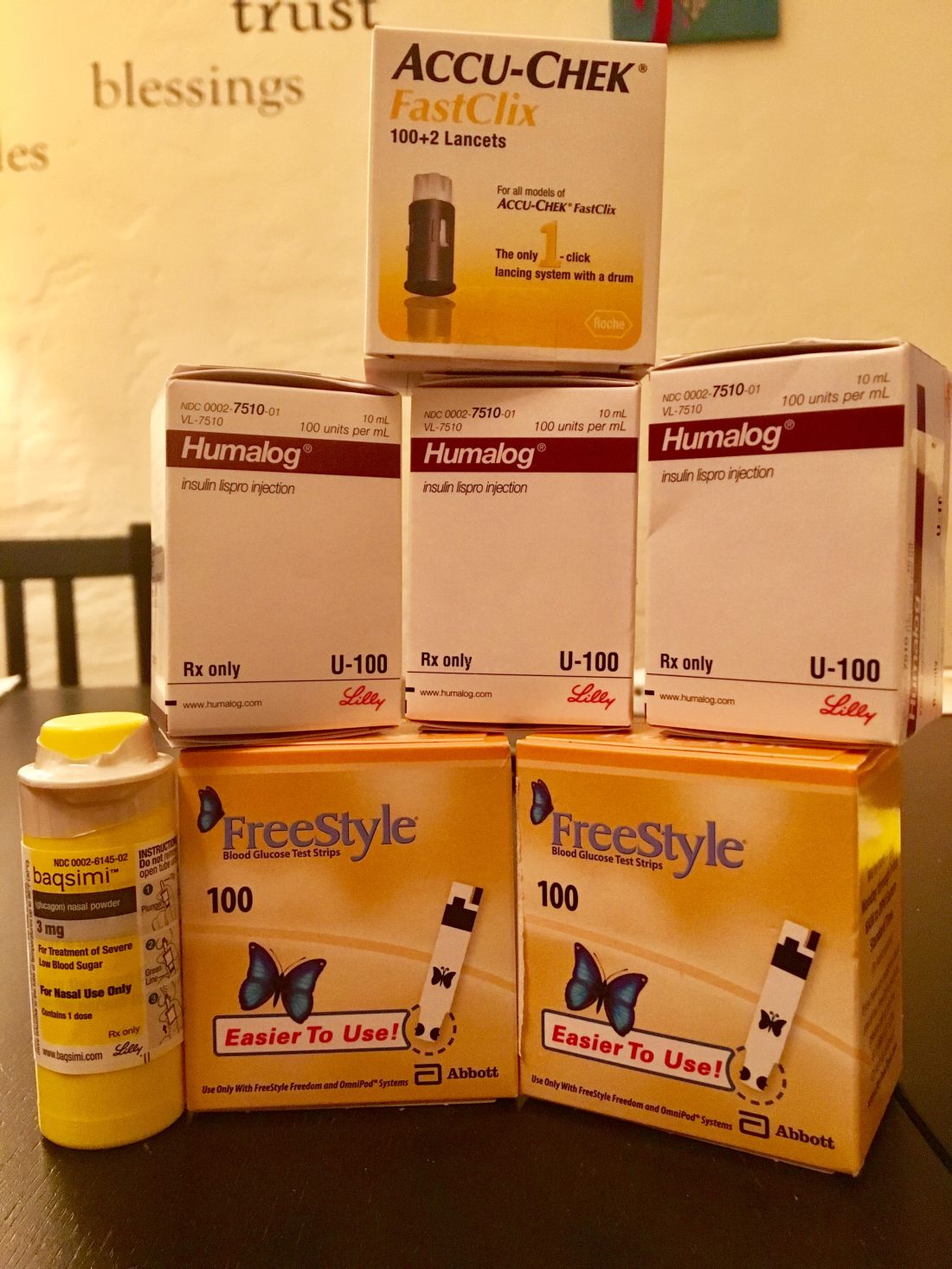
Eight Weeks

Eight weeks. This picture was eight weeks in the making. I had a change in insurance this summer, which entailed navigating a new insurance company, with its different rules, exclusions, co-pays, providers, and coinsurance rates for medical devices/testing/etc. Most notably (and painfully), it meant different contracted pharmacies and Rx rules. We were incredibly fortunate to obtain a coveted endocrine appointment the same week our new insurance took effect. Yes, it involved a lot of calls and various people advocating on our behalf. And it involved an amazing, flexible, dedicated, hard-working endocrine team.

After dealing with five different pharmacies over the course of eight weeks, my son finally has all of his prescriptions. I am so grateful to the endocrine team who helped us navigate the prescription issues and search for solutions, especially when it seemed that everyone on the other end of the insurance phone calls gave conflicting answers. I lost count of the number of times they submitted and resubmitted prescriptions. Throughout this process they were accessible, helpful, and empathetic. Each time I felt as if I was bludgeoning my head against a wall, they went the extra step to help.

All things considered, even despite a nearly herculean effort, we are luckier than many. With the skyrocketing price of insulin, had we been without insurance, no amount of navigational help would have spared us the $1200 price tag for a one month supply of my son’s insulin. And that price is up 50% from when he was first diagnosed three short years ago. 

In case that reality is not humbling enough, consider a few other factors.

1. I have private health insurance

2. English is my first language

3. I like to believe that I am reasonably well-educated 

4. I have experience working with medically complex patients and, as such, some limited experience dealing with insurance companies, vendors, pharmacies, etc.

5. I have transportation, which increases my access to doctors and pharmacies (including being able to go back and forth to the pharmacy more times than I care to admit)

My point is not to brag about my relative good fortune of “only” struggling for eight weeks or “only” losing “x” number of hours on the phone. Insider secret: do not, under any circumstances, keep a running tally of the number of hours/days/weeks of productive life lost to phone calls to insurance, vendors, pharmacies, and the like. Unless, of course, you also want to find yourself navigating the mental health system as you slowly lose your grip on reality! To that end, I am very grateful for both external help from my son’s providers, access to care, divine providence, the universe, karma, and some luck. 

But as a pediatrician, mother, and in solidarity with a larger community of caregivers, I have an obligation to state that the current global situation surrounding insulin pricing is floridly unethical. November 14th is World Diabetes Day, a date chosen because it is the birth date of Sir Frederick Banting, who won the 1923 Nobel Prize for being the first person to extract insulin from the pancreas. Banting’s discovery is what keeps the 1.25 million Americans with Type 1 Diabetes alive every single day. Banting’s discovery is what is keeping my son alive tonight, as he lays sleeping in his bed while I write this. And on the eve of World Diabetes Day and Banting’s birthday eve, I feel he would roll over in his grave if he knew that 1 in 4 patients with T1D admits to rationing insulin. I will even go on record and say that I have done it. Something has to change in this country for the more than 1 million patients living with T1D. And while I know that change is coming, I hope and pray it will be expedient, as many patients with T1D do not have eight weeks to wait. Happy World Diabetes Day! May both your insulin and your coffee be long-lasting!
An Ordinary Saturday

There was not supposed to be anything particularly auspicious about Saturday, November 5th, 2016. It was going to be an ordinary Saturday. In my Saturday uniform of yoga pants, hoodie, and flip flops, I willed it to be a normal Saturday, as I performed my typical weekend grocery run. Shortly after arriving home and feeding my son lunch, he walked over to his toy mat, threw himself down on the ground, and began to cry out in a way that sounded eerily sad and almost as if he were in pain.

Moments prior I was talking to a friend and colleague, a pediatric neurologist, about my son’s strangely disrupted sleep and my concern he might be diabetic (based almost solely on a two day history of increased urination). She must have somehow sensed I needed that extra push to get beyond the fear that I was merely being neurotic, and she said “you know you are going to have to bite the bullet and test him, or else you are going to drive yourself crazy.” I knew she was right, and upon hearing his cry, I packed him up into the car and drove him to urgent care. 

Our pediatric urgent care was just closing, so I drove him to one closer to my own office that I knew had extended hours. When I arrived, I told the medical assistant (MA) that my son had polyuria (excessive urination) and polydipsia (excessive thirst), and I was here to test him for diabetes. So he cleaned him and placed a urine bag on him to test for glucose (sugar) and ketones (indicative of acid build up, a known complication of diabetes) in his urine. When the attending physician entered the room, I explained that my son had been having polyuria and polydipsia, words which she must have thought I googled, because she responded to say it “is probably just post-viral.” My gut reaction was that she had made that up and was using it to reassure me without unilaterally dismissing my concerns. 

But I paused for a moment. As someone who spends much of her day telling parents that what their child has is likely viral, I considered how much I hate being doubted by parents. So, I gave her the benefit of the doubt, but asked if we could just test him anyway. Afterall, the urine bag was already on him. I also hate when parents try to insist on tests, as I do not like to order tests when they are not necessary, but I was not asking for anything expensive or invasive. She acquiesced and stepped out of the room. 

I admit I felt a little silly, as if maybe I was overreacting. Mildly content with her explanation, likely only because that would have been a much better outcome, I settled, momentarily, into the notion that everything was fine. I was more than willing to believe that there are many medical entities about which I am completely unaware. So I decided to do the one thing that drives myself and most doctors crazy. I googled it. I found nothing. Not a scholarly article or even a “fluff” non-evidence-based article on the topic. Any slight validation I might have felt was massively overpowered by concern for the alternate explanation. This all transpired quickly, although it felt like hours, and at this point my son had peed into the urine bag, so I had the MA take it off in order to test the urine.

In reality the time spent awaiting the results was probably not more than twenty minutes, but it felt like a long time before the doctor returned to the room. At first she did not say a word. She merely let a small but audible sigh escape her lips. I immediately began crying. Before she could say anything beyond, “I was surprised,” I burst in with the words, “it’s OK. I already knew.” I am still not sure why I did that. I think it was a combination of having been in her place as a doctor and being charged with the task of delivering bad news, plus my own past experiences of receiving (or not receiving in a timely fashion) a difficult medical diagnosis. Then of course there is also the fear that once the words are uttered, it becomes real. But I distinctly remember sensing the awkwardness of her having to tell me that she had been a bit quick to attribute his symptoms to a virus, and that I wanted to make her feel more comfortable because, as physicians we all make hasty assumptions at times. 

She asked how I knew, and I told her “I am a pediatrician.” Understandably, she then asked why I hadn’t led with that particular tidbit of information. It was a bit of a blur, but I think I said something less than insightful such as “I don’t know.” However, the truth is twofold. 1. When I teach residents, I often tell them that when a parent (especially when it is not their first child) tells you something is wrong, you owe it to them to listen. If a parent is significantly concerned, my senses go on high alert, because they are often right. Thankfully she did listen to me and agreed to test him. 2. I did not flaunt the pediatrician card, because I did not want to be a pediatrician that day. I wanted to be his mom. That was the role I needed to fill that day, in that moment. Perhaps that role allowed me those extra moments I needed to bask in denial. Maybe I just needed an objective party to be the one to confirm my fears

So it was there, on what was to be an ordinary Saturday, that the last moments of prior normalcy slipped from my grasp. Three years later I can only vaguely remember what “ordinary” even looked like, as it was eclipsed by our new normal. But three years later, one extraordinary four-and-a-half year old kid is celebrating his 3rd Diaversary! November is diabetes awareness month, a time to celebrate all the kids and adults who, like my son, are extraordinary heroes.

Caffeination for the Journey

By show of hands…have you ever had such a long week, that by Wednesday afternoon you were reasonably sure that no one would blame you for starting your weekend early and skipping out on the remainder of the week? Alas, I see that is all of you. OK, you can put your hands down now (and thank you to those of you wearing deodorant). Now as the majority of you are dragging yourself across the finish line this week (TGIF), I imagine that many of you did so with the fantasy of sleeping in this weekend. While I can only speak for myself, I know that I promised myself lots of “catch up” sleep as motivation for getting through this week. But then I remembered a slightly inconvenient fact…that I will be forgoing some of that coveted sleep to get up early and drag myself across a different type of finish line. That is because this Sunday morning is the annual JDRF OneWalk.   

I cannot believe it has been almost 3 years since our lives were forever changed by type 1 diabetes (T1D). After we made it through the first year, I recall feeling almost empowered in a way…as if we could do anything as a family. And, even on the days where I require an extra cup or two of coffee, I still believe we can! 

But what I did not know was that surviving that first year was only the beginning. Although we had tackled a year of medical firsts, there was much more to T1D than this pediatrician and single mom of three recognized. This last year, in particular, has begun to teach me how truly little I knew and appreciated about the social, emotional, economic, educational, sibling, family, and professional implications of T1D. As we humbly attempt to navigate the many facets of T1D, I feel a renewed sense of the need for education, awareness, and advocacy for all people and families living with type 1 diabetes.  

Even now, more than two years into this journey, I still think back on those days in November 2016, when I was forced to reckon with both my intuition as a pediatrician and my inner mom voice, both of which whispered, “your child has diabetes.” That whisper grew to a louder whisper and then to a shout, over the course of two days. On November 5, 2016, shortly after my son turned 20 months, he was diagnosed with type 1 diabetes. That day marked the beginning of a new journey for him, and for our family as well. He is now 4 years old, and while this path has had many twists and turns this last year, we are grateful to have friends and loved ones by our side. 

This Sunday, hundreds of patients with T1D, along with their loved ones and friends, will gather at the Rose Bowl in Pasadena, to walk a leg of this journey together. Each year all over the United States, there are similar JDRF OneWalk events. I hope that you might consider lacing up your shoes and walking alongside the T1D community as well. Like any journey with a T1D, I promise there will be snacks! And coffee…you can never have too much coffee.

For more information or to find an event near you: https://www2.jdrf.org/site/SPageServer?pagename=walk_homepage

Welcome To The Group…

I would like to think it was fitting that I spent the last night of my dear friend’s (all-too-short) life raising money and awareness at a JDRF fundraiser, for it was diabetes that first bonded us. Unfortunately, we were bonded by another illness, cancer. And it was that illness which caused her to breathe her last breath a handful of hours after I returned from said fundraiser. It was shortly after I emerged groggily from my bed, having perhaps overestimated my ability to stay up so late (and having slightly underestimated the appropriate food to cocktail ratio the night prior), that I learned of her passing. She had been on hospice a few short weeks, and I admit that each day I wondered if this would be the day that the world would lose an amazing woman, mother, physician, and friend.

I admit that my friend and I had what you might call an unusual friendship. It was non-traditional in the sense that our entire friendship occurred through the mediums of text, phone calls, social media, and messenger. Yes, that means we have never met in person. We live in entirely different states, 1300 miles away from one another. Yet, we led eerily similar lives, which united us in ways that likely no two people would ever hope to be aligned.

I first “met” her the day after my youngest child was diagnosed with type 1 diabetes. He had just been admitted to the hospital, and I posted in a private physicians group about what it was like to watch my then 20-month-old son get his first insulin injection. She reached out to me, and the next thing I knew we were chatting away on the phone as she helped me navigate my first few days and weeks as a MOD (mother of a diabetic). Her own son had been diagnosed many months prior, and she already had some experience under her belt with navigating medical devices, carb counting, and the other details of the day-to-day care of a diabetic toddler. She understood what it felt like to be a mother, and a pediatrician, dealing with this disease, and her advice and support were invaluable to me. As I traversed the path from a pediatrician ordering all the shots, to a mom giving the shots, she was the one that shepherded me along the way.

Quite ironically, we had both been pediatric hospitalists (pediatricians who care for patients admitted to the hospital). I had transitioned to outpatient (working solely in the clinic) about 3 years prior to my son’s diagnosis. Shortly after we became friends, she considered and ultimately made a similar transition to outpatient medicine. Sadly, her tenure in the outpatient world would be way too short.

We both had three children, including an older daughter (hers a few years younger than my own) and two younger boys (hers are twins, mine are 5 years apart). Our type 1 diabetic boys even looked a bit like one another, and we kept saying how we needed to get the boys together. My heart aches when I consider that this particular play date never occurred.

As a person who values physical presence and touch, it might seem odd to feel so close to someone whom I have never hugged, other than in a virtual fashion. But sometimes empathy forges powerful connections that transcend physical distance. Something within me recognized and connected with something…many things… within her. And because of that recognition, my life was touched by having her in it. Likewise, because of that same connection, I now feel the void left behind by her absence.

Having been first diagnosed with cancer at an early age, I have had many occasions in which to experience survivor guilt. Most would say it is a good problem to have. And it is. I am grateful to be a survivor. But survivor guilt is a very real thing and in no way diminishes the gratitude of the survivor. And today that survivor guilt weighs more heavily than in the past. It is not merely because she and I both had a similar type of cancer (hers clearly worse than my own), though I have contemplated that particular unfairness on more days than I can count since she was diagnosed. It has less to do with our uncanny similarities, and much more to do with the fact that I know how incredibly heartbreaking it had to be to leave behind three young children, including one with a medical illness of his own. It is the pain of knowing that your babies need you, and that you will not be able to be there.  While I am sure she took some solace in knowing that her children will be loved, nurtured, and cared for, that knowledge cannot erase the reality she faced in these past few weeks. While I am grateful that her suffering has ended, I wish God and the universe had granted her more time with her children (and, selfishly, with the rest of us as well).

However, despite all that cancer has robbed us of with her passing, she managed to touch so many people in such a short time. And those memories will hopefully ease the ache that we now feel without her presence, physical or virtual. One of my first memories of her was during our first conversation, as I stood in my son’s hospital room with tears in my eyes. At the time she jokingly welcomed me to the “group that no one wanted to be a part of.” It broke my heart a year later when I welcomed her to the other “group that no one wanted to be a part of” after she was diagnosed with cancer.  My sincere hope is that her children will know there was one more “group” to which she belonged as well. A “group” that defined her more than her identity as a pediatrician, mother of a diabetic, or even a woman with cancer. It is the “group” of women who support, empower, and touch the lives of others.

Rest in peace, my beautiful friend. Your time here may be done, but your work continues.